

Unfortunately, I am not Fred Flintstone and can’t be in two places at once. Fortunately, the buzzings of rumor saved the day again. “Fun. Festive. Humorous. Friendly competition.” These are the words that described the evening, according to our Erika whose shining moment was spelling O-R-O-O-N-O-K-O. Here’s how the night went down. Eight brave contestants took turns spelling. Via a three strike system, one by one each contestant struck out until only one remained. The prize: an autographed copy of a David Liss novel. The judges: Bill Fisher compiled the list of words while David Liss read a sentence from his boo k from which spelling words were pulled— anything in the book, including the names were fair game. The Cheerleaders: Plenty of smiling spectators. The winner: Terri Echols, whose preparation showed with only one strike. The pleas to duplicate this event again in the future will hopefully be granted. As Erika states, “This event represents what Gemini Ink is all about. All the different components of literary arts and community came together.” By the way, thank you for all of the donations at the end of the night. They are greatly appreciated.
—Paul Hoeg, Gemini Intern.
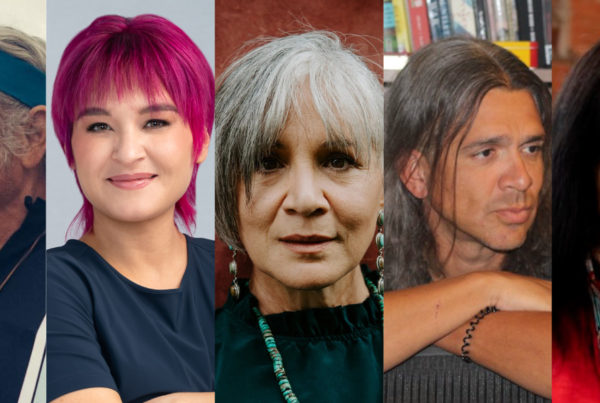
Gemini Ink collaborated with the English and Mexican American Studies (MAS) programs at Northwest Vista College (NVC) to present a community talk with a panel of four women sharing their experiences about becoming United States citizens. Over 100 people packed the conference room.
To begin, poet, writer, and NVC faculty member, Natalia Treviño, read from her story “The Naturalization”, among those included in a new book, Shifting Balance Sheets: Women’s Stories of Naturalized Citizenship & Cultural Attachment. The story shares personal insights about the process her mother and siblings went through to become U.S. citizens. A talented writer, her words painted pictures for the audience to feel, smell, and see the experiences as she recalls them. Culture, tradition, language, hopes and dreams are all part of those who come to the U.S. seeking citizenship.
The youngest member of the panel, Fernanda Macedonio, born in Southern Mexico, is now a senior at Medina High School. She shared the journey to Texas she made with her mother at the age of 10. She acknowledges she came to the U.S. illegally but stated that it would have taken 10 years living without her mother if otherwise. Nearly 18, Fernanda 18 plans to start the process of becoming a citizen so she can further her education at Texas A&M University in College Station. She feels that being in the U.S. has offered her opportunities Mexico could not, stating, “As much as I love my country of birth I know I won’t go back there.”
Fatemeh Rezapoor is a proud Iranian who came to America on a marriage visa. Her experience as an Iranian in America has been different, and she holds dearly to her roots. She lives with her American husband and children and talked about the common question people have asked her “what if the U.S. starts deporting Iranians back to Iran for some reason?” She said she has no problem going back to Iran, but she wants a passport to gain the privilege to travel without hassle.
Director of Northwest Vista College’s Community and Public Relations Renata Serafin also shared her story of obtaining her green card to become a legal alien 20 years ago. She remembered some rough times: because of political uprisings, her father left her family in Poland when she was 12. During the time of his absence she coped by writing him letters and poetry of her memories with him. Her father got a sponsor to the U.S. and then the lengthy process began for her mother and sister to follow. Renata recalls that the U.S. was welcoming towards European immigrants but not towards the special needs and abnormalities of her sister. Her mother ensured they all stayed together until 1985, where at age 14, Serafin, her sister, and mother finally made it to America. It was hard at first because she felt she was marked. “You’re different; you’re somebody else who doesn’t belong here.” When Renata decided to become a legal citizen 20 years ago she did so to pave the way for her family to say: “If I can go through this process, you can too.”
Though the women were from different countries with different backgrounds, their stories shared the common thread of the struggles of carrying their culture, ideals, language, and desires to a foreign land. The process to become legal citizens of the United States is more complex than most of us realize and the journeys those must go to obtain what we, as citizens, take for granted are often overlooked and go untold. Unfortunately, the session was only an hour long and there was no time for a question and answer session. Overall, I think those in attendance left with a new awareness of the naturalization process, and the topic definitely sparked discussions which followed the attendees out the door.
-Dolores, Gemini Intern.
In preparation for November, National Novel Writing Month, author David Liss taught a class on “The Thirty Day Novel: Crafting a Solid, Workable, and Complete Draft in One Month” at Gemini Ink on October 29, 2011. Mr. Liss shared some good tips on accomplishing this feat.
To complete a rough draft of a novel (approximately 50,000) in a month:
- Write about 5 pages a day
- Write everyday at the same time everyday – whether you want to or not because it is better to go back and erase what you have written than to not write at all.
The most important thing in writing a novel:
- Plot is Character – the only thing that matters is what happens to the character(s).
- Characters should be developed, meaningful, and interesting people that the readers will want to know — novels and stories succeed because of the characters!
- Conflict is the most important part of developing the character(s).
- The novel should explore who the characters are, what they want, and why they cannot have it.
- Every scene should be about the character(s) struggling to accomplish something – characters that never face resistance are not interesting.
When you want to give up, remember:
- “Doubting what you are writing is part of being a good writer”
- Take aspirations to write seriously.
- There is no magic to it (writing a novel in a month) – Just get it done!
- Dolores, Gemini Intern
As told by the forty plus people who showed up, last Tuesday’s Writers Respond to Art, featuring the work of Diana Monteja no, Mike Greenburg, Wendy Barker, and the music of Kathy Mayer, proved a wonderful success. Our Carolene, who attended the event at SAMA stated that: “Last night’s Writers Respond to Art was sensational. The lyre musical interludes, the Greek urns, the three poets giving uniquely different presentations—all came together in a special evocative way.” Even the lovely, balmy weather agreed with the splendid evening.
As for the David Liss class Saturday, the only word to describe it is smooth. Ferociously scribbling down notes, I felt like I was in another college seminar absorbing all the professor had to offer. There were some other published writers attending the class as well, which made for great discussion. With the help of the Subway lunch, overcoming my humility, even I asked a few questions. What amazed me the most was the volume that Liss reads and writes: a book in a week and a half, and every novel written, drafted in a month. Truly writing is work; it is a craft. Everyone has great ideas, but the writer is the person that can take those ideas and craft it into something people want to read. As an aspiring writer, this was the perfect class for me to prepare for my NaNoWriMo attempt.
-Paul Hoeg, Gemini Intern