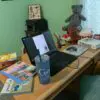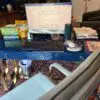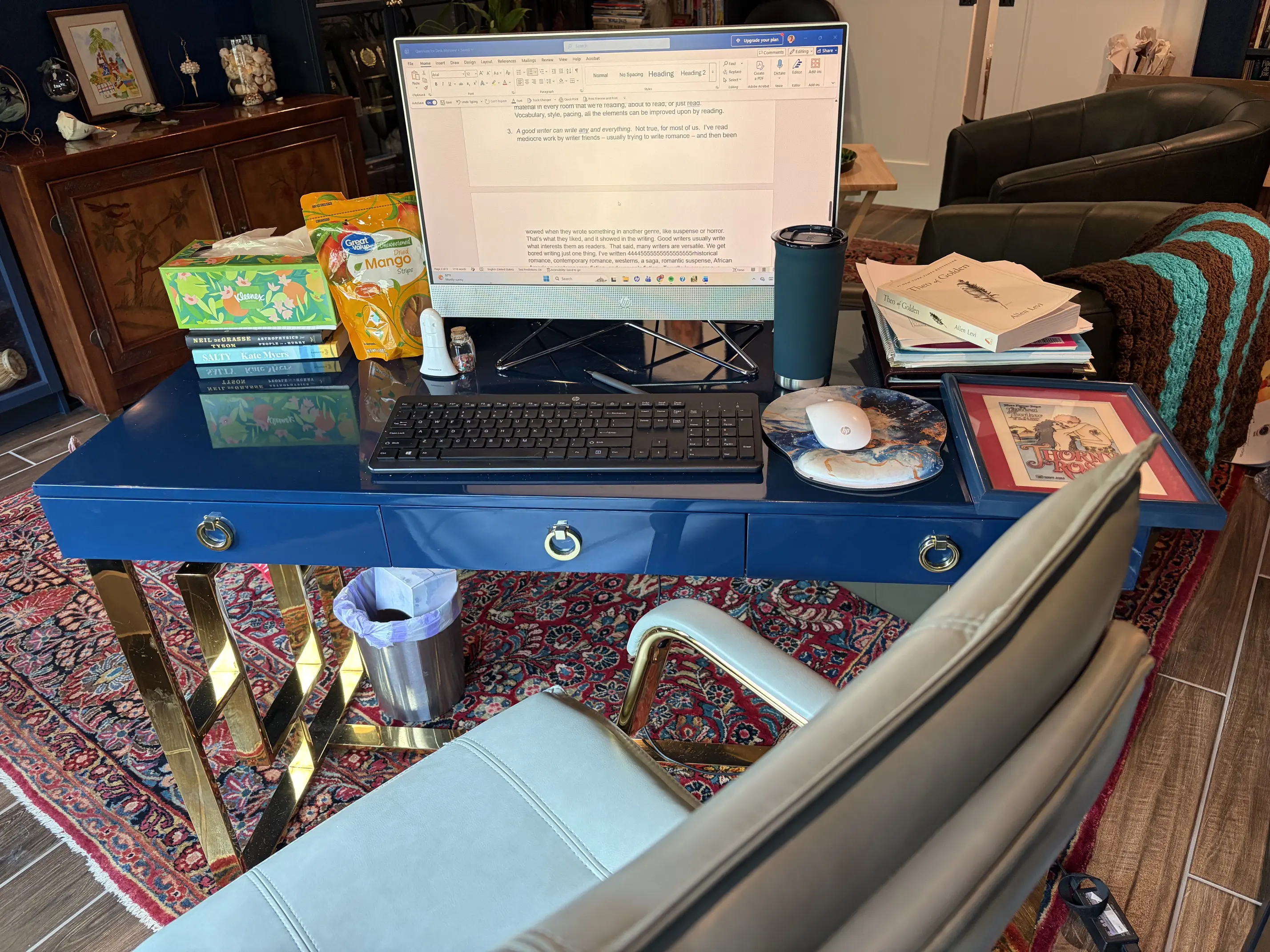
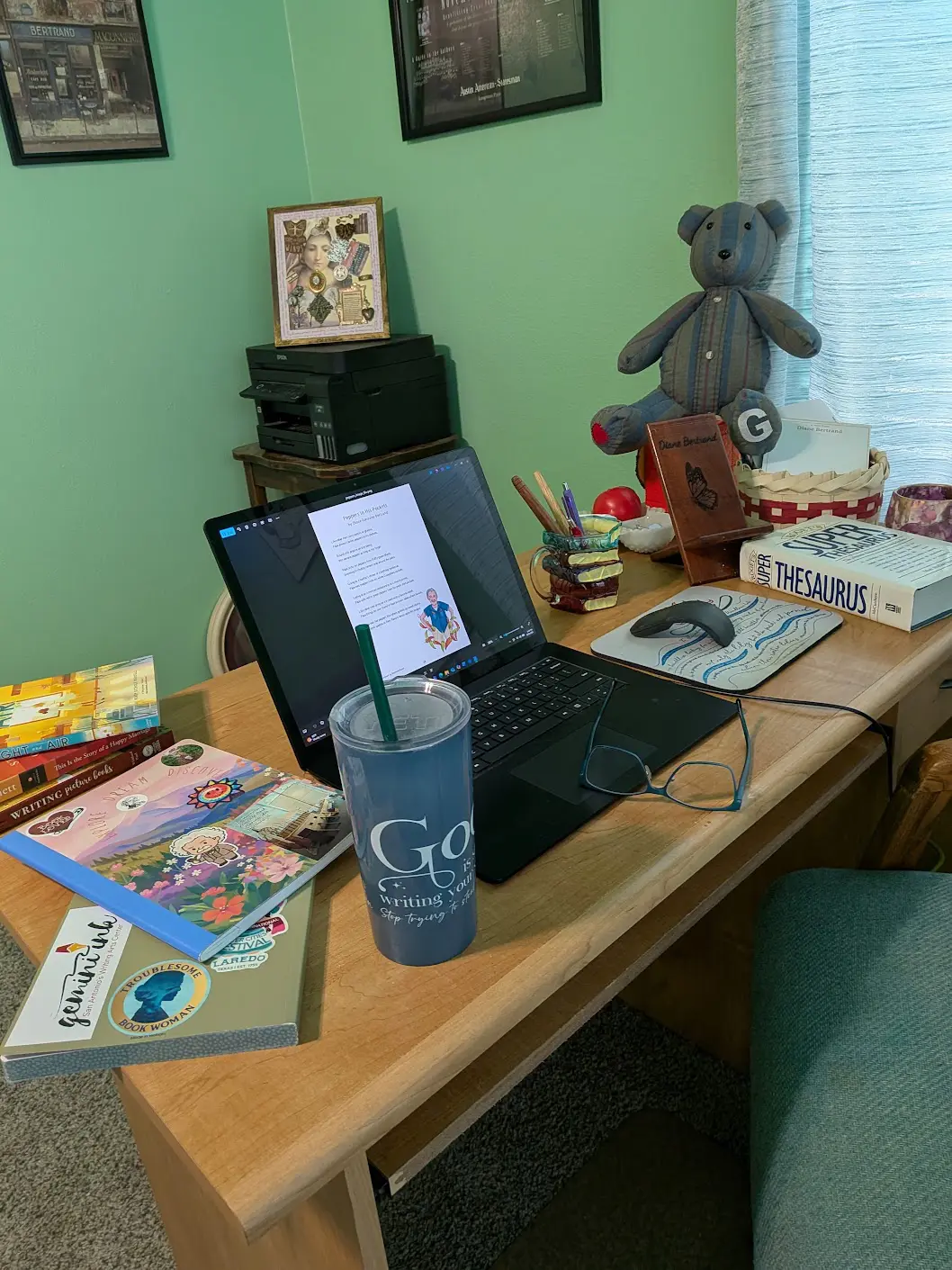

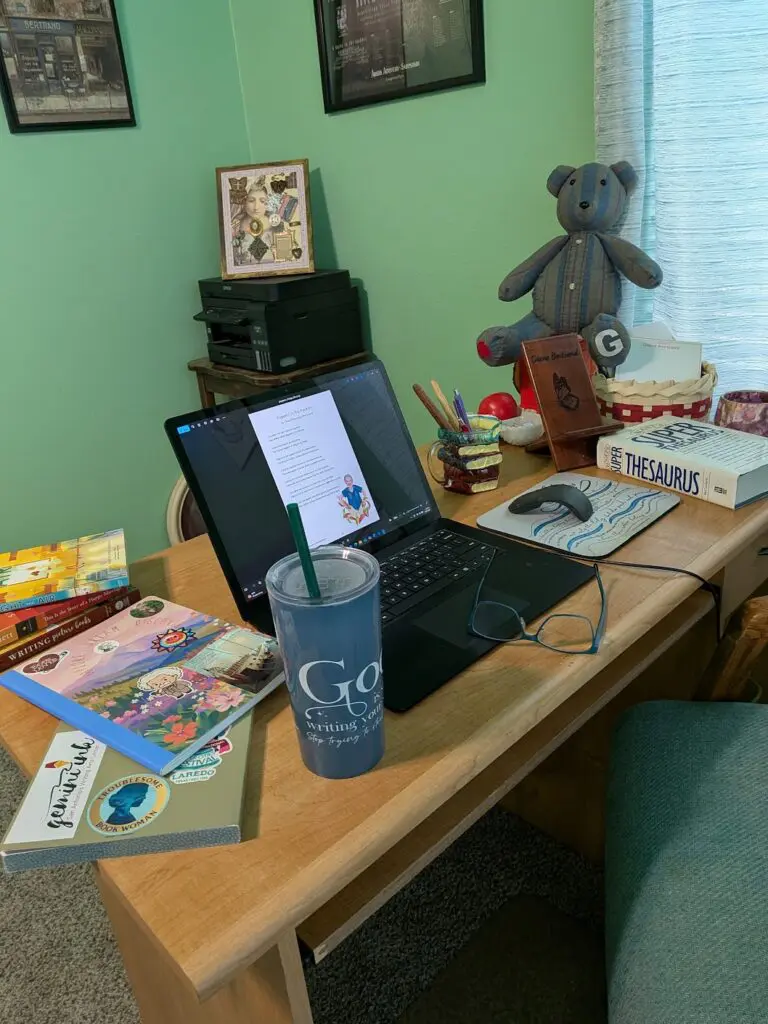
The Writer’s Desk features the desks and writing practices of Gemini Ink faculty, visiting authors, teaching artists, volunteers, students, interns, staff, partners and more. Receive new posts in your inbox by subscribing to our newsletter at bit.ly/geminiinknewsletter.
Join Diane Gonzales Bertrand on Saturday, September 12, 2026, 10am-3pm CST, at Gemini Ink, for her workshop: Diving into the Kiddie Pool: Writing for Picture Books. This course is open to writers of all genres and skill level, 18+ and will look at storybooks and discuss what works and what doesn’t work.
Hi Diane! we’re so happy to have you teach this workshop for us. What habit do you have now that you wish you had started much earlier?
I wish I had taken poetry classes in college with my English degree. Poetry is helpful in writing picture books because language choices, clarity and precision, and lines/sentences must convey information with fewer words. Luckily, Gemini Ink has helped me fill in the gap with poetry classes and readings by contemporary poets. My graduate professor encouraged me to write for children and teens, starting my career as an author. When I work with teachers, I remind them, “A good writing teacher must be a writer too,” encouraging them to write down their own stories, essays, and poems and share them with their students.
What are some misconceptions about being a writer that you can discredit?
Many believe writing for children is “easy” because there are fewer words. Any serious children’s writer knows the frustration of searching for one word that will convey meaning, simplify the action, and engage a reader all at the same time. Multiple drafts (at least 20 drafts for me), listening to your critique partners, reading children’s books like the one you want to write but being careful your idea isn’t a duplicate, and learning from experienced authors takes time. Even after it is accepted for publication, there are more drafts from the editor’s notes. In my case, my translator has ideas about word choices that make me rethink an English word so that the Spanish text has a better flow. However, with an open heart, a creative approach, and a respect for others helping me create the best book possible, I have learned how to be flexible, to enjoy the whole process, and to celebrate the final product.
What is the one piece of writing advice that you value most?
“No writing is every finished. It is merely abandoned to publication or for a grade.” I can’t recall where I first read this quote, but I always typed it on my syllabus and emphasized it on lecture slides when I taught English composition or creative writing at St. Mary’s University. The quote is a reminder than I must let go of my poem, story or novel. If not, I face perpetual worry about a word, line, character, title etc. Are there elements I would change in some of my published works? Yes! But I learn from every piece of writing I abandon.
Who are your heroes in real life? What do you admire most about them?
My heroes are family members like my parents who taught us to “make do” with what we had. Now I know they were teaching us creative problem-solving skills as well as modeling a strong work ethic. I admire my grandmothers who were single mothers, raising their children during the Depression and World War II. My aunts and uncles were all confident individuals, loyal to their families, and worked hard to educate their children. When I look beyond my family for heroes, I am drawn to leaders who value loyalty, diversity, and creativity. I respect those who have a respect for others.
What is your motto? How does it apply to your writing?
“Trust the process.” This motto seems to suit every decision I make. From personal relationships to an appearance at a local school, I know I am planting seeds I may never see grow and blossom. Many times, it is hard to trust my process, but I am fortunate to have valuable writer friends who encourage me when a writing project seems “hard” or because a new genre makes me nervous and I want to give up. Finding a group of like-minded writers who can give me feedback is the backbone of my writing process.
Do you like writing projects to be carefully planned or to just go with the flow?
If I am writing with a goal towards publication, I tend to plan and flow simultaneously. Often I am “flowing” in my writer’s notebook. When I discover a recurring image or a title that suits a theme, I start planning how I might build or extend it into the whole project. Ideas flow when I travel to a new place or walk around a flea market and I see an object that could belong to my character. I treasure the appearance of a new ideas. I also believe in the power of “incubation,” where I roll an idea around in my head for days or weeks until something clicks as a new possibility for a character or for an event to change the course of the story completely. Nothing I write is ever wasted, even when I decide to go in another direction. My writing life is exciting, anxious, and magical all at once.
 If people want to learn more about your books, where should they go?
Most local libraries have my bilingual picture books, novels, and short story collections. You can also purchase them from San Antonio’s The Twig Book Shop. All of my books are published through Piñata Books, the children’s division of Arte Publico Press in Houston, Texas. You can order them at www.artepublicopress.com
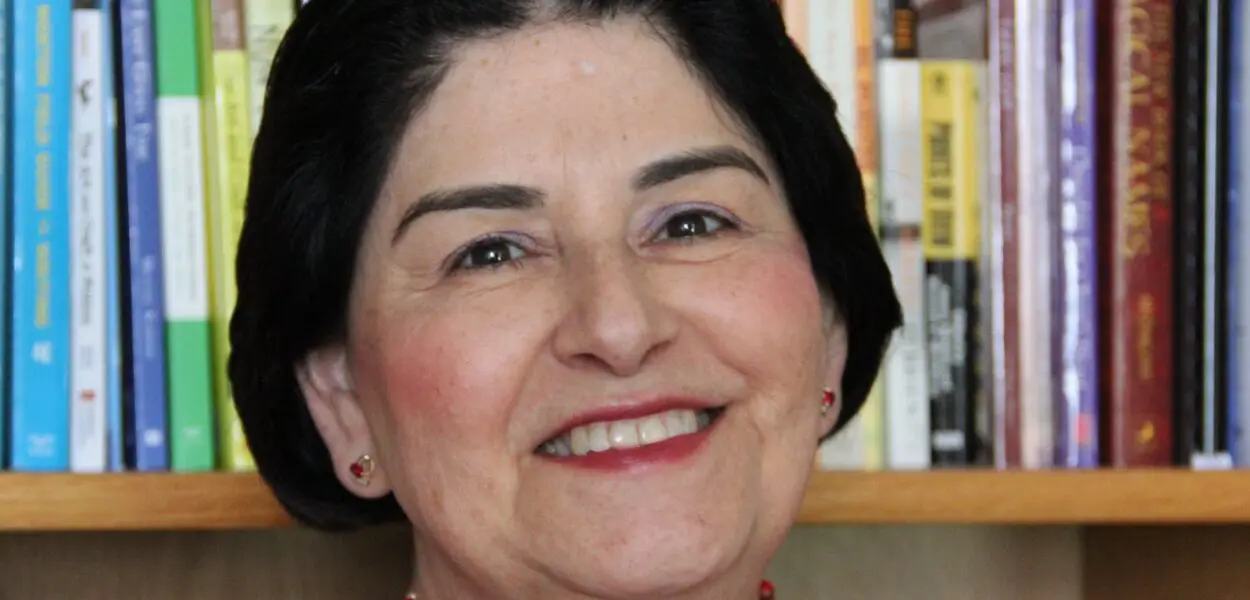
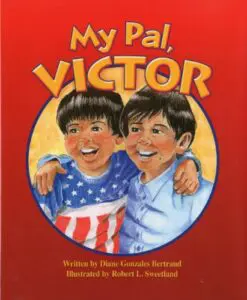
Diane Gonzales Bertrand is the author of twelve bilingual picture books including the award-winning My Pal Victor, The Party for Papá Luis, Cecilia and Miguel are Best Friends, and The Story Circle. She retired from her position as Writer-in-Residence for the English Department at St. Mary’s University in 2021. A new picture book, Music Rides the Bus, is forthcoming in 2027 from Piñata Books. (Arte Público Press, Houston, TX www.artepublicopress.com)