
The Writer’s Desk features the desks and writing practices of Gemini Ink faculty, visiting authors, teaching artists, volunteers, students, interns, staff, partners and more. Receive new posts in your inbox by subscribing to our newsletter at bit.ly/geminiinknewsletter.
Join Laura Castoro on Thursdays, Sep 10, 17, 24 & Oct 1, 2026, 6:30-8:30pm CST, via Zoom, for her workshop: Read Like A Writer. This course is open to writers of all genres and skill level, 18+. We will use close reading to examine how the writing pros achieve enviable work and how to read more deeply so we can deconstruct how the author sets the mood, adheres to or manipulates conventions, and plays with boundaries.
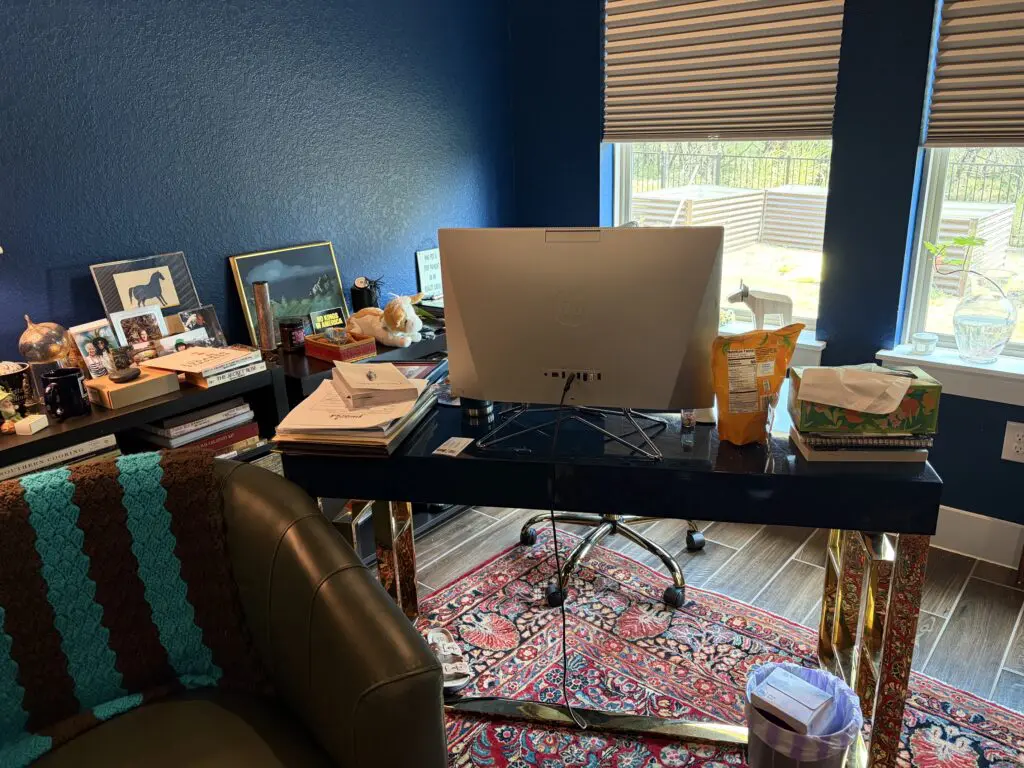 Hi Laura! We’re so excited to have you teach for us again. Describe your first writing desk. How is it different (or not) from your current
writing desk?
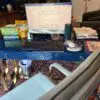
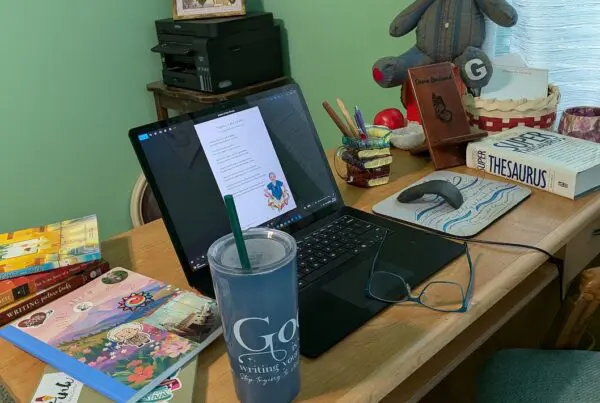
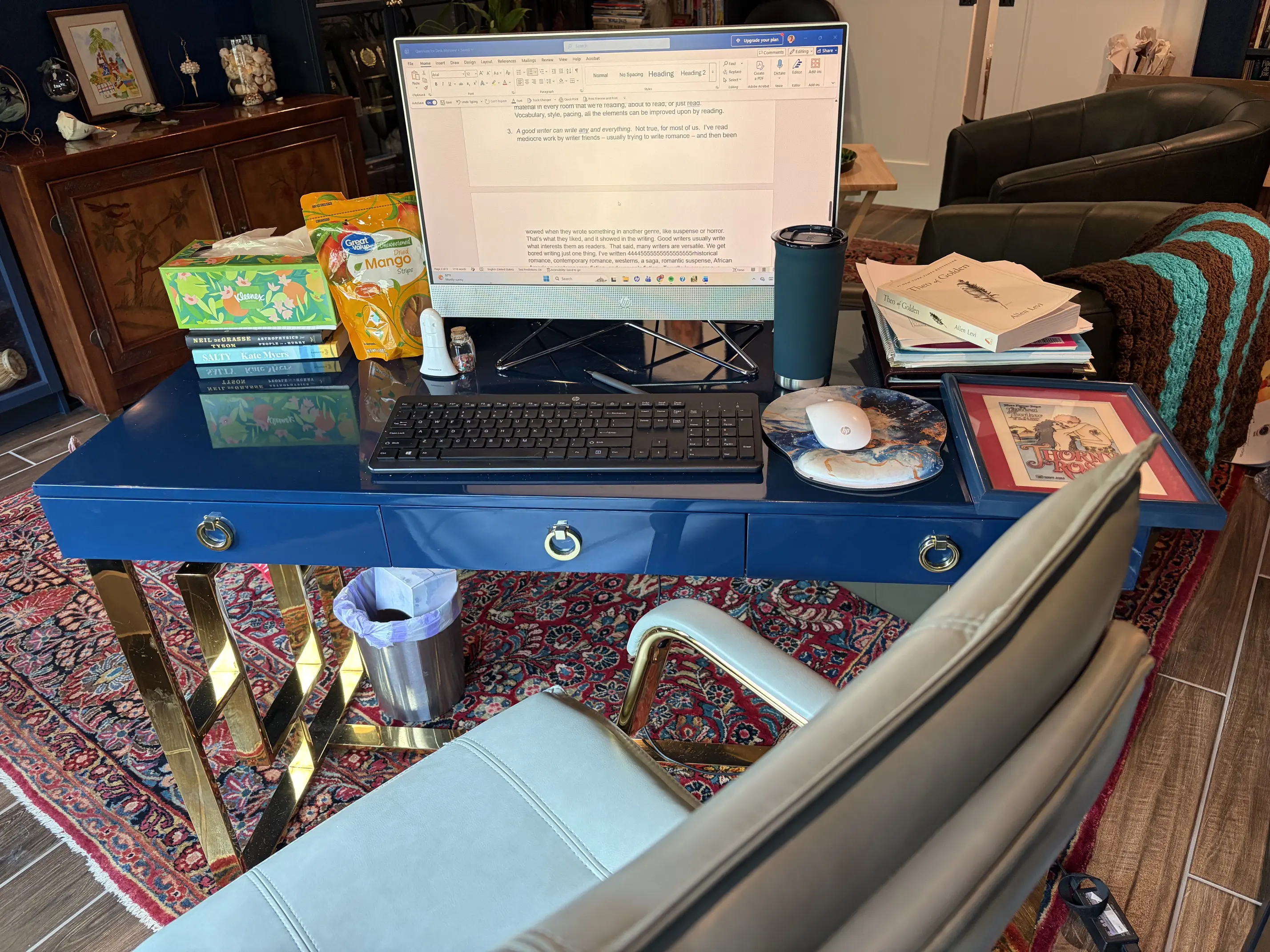
 My first writing desk wasn’t a desk at all. It was a corner of my dining room table with pen and pad in hand. My first real office was a closet that connected our garage to our family room. It was deep enough for a build-in desk and shelves on one side. When I was sitting, I could touch both doors with my out-stretched arms. Tiny but private! My current writing desk is a bit flashy. I bought it at a discount sale online four years ago. It’s shiny deep blue and brass. I like color so it’s my happy place. I’m surrounded by books and things I’ve collected and love.
How important is it to you to have stability in your writing routine?
When I’m at the beginning of a writing project, stability is everything. I need regular time alone every day. No music, no TV, no people around, if possible. A lot of writing is thinking. Especially when I’m creating a storyline. I also do a fair amount of research for my fiction. But once I’m on a roll, I’ve been known to write any and everywhere; in a car, sitting cross-legged on the floor at the airport, on a hotel bed, even between middle-of-the night feedings I shared with my daughter when her twins were born. Whether the story is coming – or not – every writer needs to be writing regularly. I did not say writing well. Some days the writing isn’t good. But bad writing days have to be allowed to happen, too. I never know what I have until I’ve written it. The editor in my head will judge later. Boy, will she!
What is the one piece of writing advice that you value most?
“Writers write.” No one knows who will become published. But it’s guaranteed that you won’t if you don’t write. That means putting in time and sweat and energy into whatever you are creating. Your muse won’t dog you. You must entice it with effort.
Do you like things to be carefully planned out or do you prefer to just go with the flow? Does this also apply to how you lay out a story?
Yes and yes. I think of myself as a “B” personality about most things. But I’m a “A” when it comes to my writing. I will chase down a detail that is bothering me, double-check my research, and so forth. However, when starting a writing project I am a Pantser. That refers to the expression, fly by the seat of one’s pants,’ or be intuitive. I don’t lock down my ideas early. I let my imagination lead the way. If a story idea comes to me, and each time I think about it something new has been added to the storyline, I know I’m on to something. Eventually a scene will come to me. Or a character sketch. Sometimes it’s dialogue between characters playing in my head, like music. I jot those things down. I’ve learned to trust my imagination. Only when I have linked enough ideas together to have maybe 50 pages or so, do I start genuinely plotting. I know writers who work just the opposite, plot in detail before beginning the process of writing chapters, and it works for them. There’s no one way to be creative. True creativity is about working outside the box all the time. How one captures that creativity is up to the writer.
What’s the most interesting thing you’ve heard or read recently?
 It’s that Dolly Parton was an uncredited producer for the hit 1990s TV show “Buffy the Vampire Slayer.” Who’d have thought she’d be involved with a show about vampires? It doesn’t fit her public ‘image.’ I already knew that the comedian Lucille Ball had championed and financially backed “Star Trek” after NBC rejected it. These things remind me that no matter how much we like to think we know about another person, especially public figures, we can’t know all. It also says that truly talented people are interested in a wide variety of things that don’t necessarily connect to their public image. This is helpful for me as a writer when I’m creating characters. Being quirky is not shorthand for developing characters with genuine depth and a philosophy for the lives they are living, even if it’s just between the pages of a book.
What is your favorite podcast and why? Why is it your favorite?
This is a tough one because I don’t listen to podcasts regularly. When I do, they are eclectic. Two come to mind.

a. NPR’s Tiny Desk Concerts. I hear music from artists I already like and many I’ve never heard before. Keeps me adding to my collection of liked songs.
b. Hidden Brain. A science show that “explores the unconscious patterns that drive human behavior and questions that lie at the heart of our complex and changing world.” The most recent one was titled, “What Art Does For Your Brain.” After reading the above answers you will know why this show interests me.
What are some misconceptions about being a writer that you can discredit?
So many! Here are three. Especially for fiction writers because we make things up.
a. If you’re talented writing will come easy. That’s not true for most writers. There are days when everything is just flowing from your fingertips, but those days come for me after I’ve been working hard for weeks on a book.
b. You need a certain kind of education to be a writer. The only qualification that I think is absolute is that a writer must be a reader. Most of us have a stack of reading material in every room, books that we’re reading, about to read, or just read. Vocabulary, style, pacing, all the elements can be improved upon by reading. And, there are so many classes now taught by professionals – all the Gemini Ink classes – that even seasoned writers can learn a few new tricks.
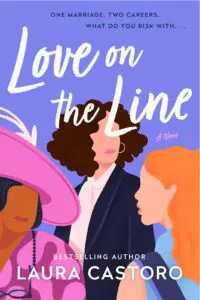 c. A good writer can write any and everything. Not true, for most of us. Good writers usually write what interests them as readers. I’ve read mediocre work by writer friends – usually trying to write romance – and then been wowed when they wrote something in another genre, like suspense or horror. That’s what they liked, and it showed in the writing. That said, many writers are versatile. I’ve written historical romance, contemporary romance, westerns, a saga, romantic suspense, African American contemporary fiction, and women’s fiction. To write in any area, a writer must find a way to engage with the material. And, most important, understand what a reader wants from the experience of reading a story in that genre.
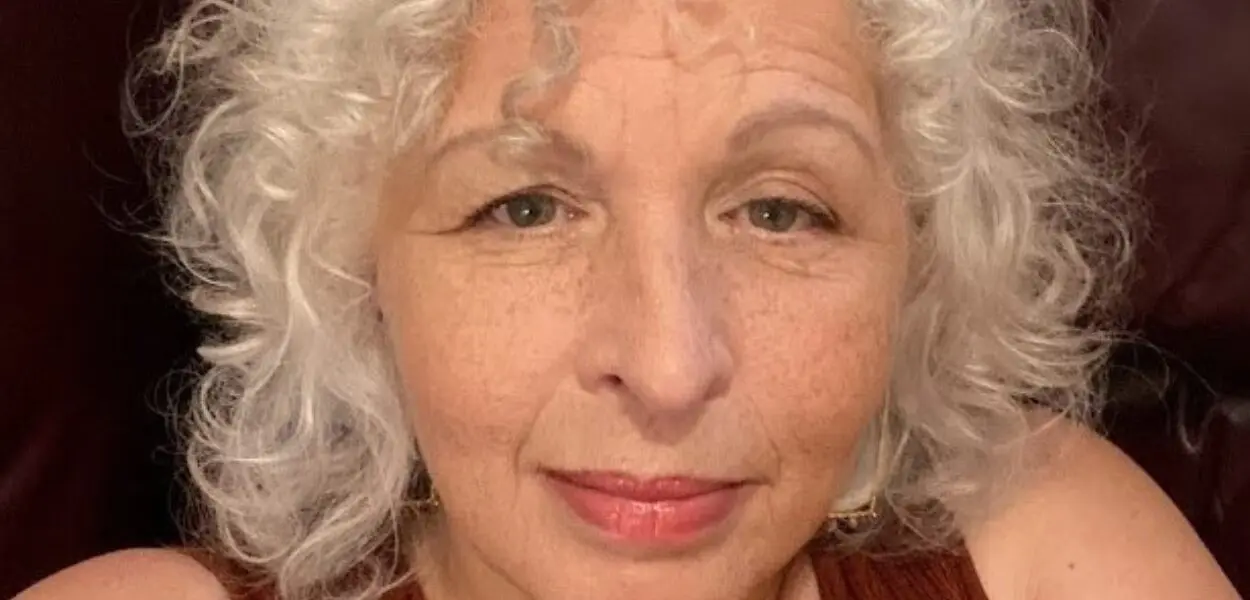
Laura Castoro, a USA Today, Amazon top 100, and Apple Books bestseller, has published 47 novels with major publishing houses such as Dell Books, Berkley, Avon, Warner, MIRA, Harlequin, Kensington, Pocketbooks, Harper Collins, St. Martins Press, and William Morrow. Laura has won multiple national writing awards. In 2005 she was inducted into the Arkansas Writers’ Hall of Fame. She is a past president of Novelists, Inc. (2013), an international professional fiction writers’ organization.